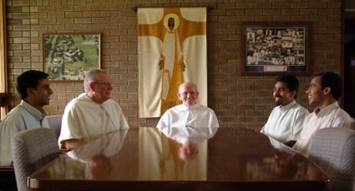
Vocations It was said of St Norbert that he was "prepared for every good work." We ground our action in our religious profession, by which we also dedicate ourselves to the contemplative aspect of our life. Thus, we share the riches of our spiritual tradition by inviting the participation of others in our liturgy, imbued with a sense of the sacred, and centred in St Joseph's Priory Church. We invite them to share the Gospel challenge epitomized by the spirituality of St Norbert in which Eucharistic piety, fidelity to the Church, and a life of austerity and apostolic zeal are marvellously united. (Pope John Paul II, 1985) We commit ourselves to sharing the unity and peace we strive to build together with those to whom we minister, thus collaborating with God in what He is doing in the lives of others. Convinced that we have a unique contribution to make to the Church in Australia, we invite others who see and appreciate the value of our Norbertine way of life, to join with us in accepting the challenge of the on-going formation of ourselves and the people of God. We rely on the providential goodness of God to raise up people to respond to His call to incarnate this timeless tradition in our land, and be witness to the Apostolic Life in the spirit and fellowships of Christ. Energized in this way, and under the protection of the Immaculate Mother of God, Help of Christians, we look forward to expanding our apostolate to the wider Australian Church. The original Priory was built in 1965 and the Norbertines have enjoyed the support and hospitality of the local community since that time, with a number of additions enhancing our priory over the years. Currently there are four Norbertines in residence, with two others serving in local and country community parishes. The Priory adjoins the Church of St Joseph and St Norbert College, with whom the Norbertines have always enjoyed a special relationship with both staff and students. 10 KEY ELEMENTS IN NORBERTINE SPIRITUALITY God calls everyone to holiness within the context of the life in which they find themselves. Spirituality is a means to this holiness. Our Norbertine spirituality draws its life from the call of the Father, the redemption by the Son and the sanctifying work of the Spirit. 1. LOVE GOD When Jesus was asked about what commandment he thought was the greatest, his first answer was, "Love God." Norbertines follow the Rule of St. Augustine whose first words echo Christ’s. "Before all else dear brothers, love God." Authentic spirituality begins and ends with love. All spiritual progress is measured by our capacity for love. And the beginning and end of all love is God. The Norbertine is challenged to love God from the moment he puts on the white habit until the day he surrenders himself to God in death. Love is the greatest virtue and contains all the others. 2. LOVE PEOPLE Jesus completed his comment on the greatest commandment by saying, "Love your neighbour as you love yourself." Jesus composed his law of love by combining the words of Deuteronomy and Leviticus. Love is like the robe of Christ, a seamless garment. Whoever loves the Father, loves the Son. Whoever really loves Christ will love people. Augustine’s Rule calls Norbertines to love of neighbour. Abbot Pennings, founder of St. Norbert Abbey, chose as his motto, "Let us love one another." St John writes that the person who claims to love God without loving the neighbour is a liar. Norbertine spirituality understands that loving people is a standard by which love of God can be verified. 3. LIVE IN COMMUNITY The Acts of the Apostles describes the first Christians as forming a community of love, based on prayer, the sharing of goods and the celebration of the Eucharist. Augustine’s Rule calls the Norbertines to live in community. Why? "The main purpose for your having come together is to live harmoniously in your house, intent upon God in one heart and mind." What is the quality Augustine requires for community? Harmony. He uses a musical image based on the sung psalms. "Behold how pleasant it is for the brothers to live in unity.” Augustine comments that "this music, this sweet melody, which is savored as much by the mind as in the singing, has given birth to the common life."
It was St. Norbert’s gift to see the value of spiritual formation through living in community as a creative force that complemented pastoral service to the Church. The primacy of this communal formation is beyond doubt. The members make progress in becoming one body, nourished by the one Bread. They seek one heart because only one love in the Spirit penetrates their capacity for loving. They want one soul in God to animate all their actions.
4. EMBRACE POVERTY Jesus made poverty of spirit the first of his pathways to happiness – or beatitude. Augustine shaped that teaching into a communal practice. "Call nothing your own, but let everything be yours in common." Norbert established evangelical poverty at Prémontré and it has been central to Norbertine spirituality ever since. Our community life implies the renunciation of private property. Rich and poor are both welcome to Norbertine abbey life, but for all members of the common life, the price of harmony will involve the practice of poverty. Spirituality by its very name implies cultivating a wholesome detachment from a transitory world and opening us to the permanent world of God. It does not mean a hostility to creation. Poverty of spirit enhances and transforms creation for the glory of God and human fulfilment. This is why our Norbertine abbeys have traditionally been sanctuaries of beauty. It is because poverty teaches the members to be inventive custodians of creation and not its slaves.
5. HONOUR OBEDIENCE 6. CHERISH CELIBACY Jesus lived a celibate life, as also did Mary and John the Baptist. Jesus taught that some practice celibacy to witness the kingdom of God. Augustine expands on this by saying, "Celibacy make the life of the angels appear among people, the ways of heaven apparent on earth." St Norbert called the community to cherish celibacy and asked all to listen to Augustine’s words each week: "You must not fix your gaze on any woman. Seeing women when you go out is not forbidden, but it is sinful to desire them or to wish them to desire you." 7. PRAISE GOD Jesus participated in the public prayer gatherings of his time, regularly at the synagogue and occasionally for Temple feasts when he was in Jerusalem. At the same time Jesus sought solitude for personal prayer. Norbertines are expected to gather each day for the Liturgy of the Hours and the celebration of the Eucharist. Each Norbertine is also committed to daily personal prayer. The worship of God in the Eucharistic celebration binds each Norbertine into a community of love wherein he touches the source and summit of divine life. St Norbert led the people of his time to acquire a deep faith in the Real Presence of Christ in the Eucharist. This source of faith growth remains with all Norbertines today.
8. PRAY ALWAYS As just noted, Jesus engaged in public prayer and personal prayer as well. The Gospels note how he sought quiet places for such prayer. Augustine was aware that the chapel needs to be respected as a place for personal prayer. "If there are some who might wish to pray there during their free time, they should not be hindered by those who think something else must be done there." 9. SERVE THE CHURCH Jesus preached the Kingdom of God and the gift of salvation. He healed the sick and loved people. He died and rose from the dead to make salvation and divine life available to us. Jesus was engaged in pastoral ministry. The apostles continued this missionary work along with establishing and serving local communities, assuring their continuance and stability. Norbertine spirituality has always owned a pastoral soul, a generous outreach to the pastoral needs of God’s people. From the very beginning of the Order there has been a natural affinity of Abbey and Parish, of Abbey and Mission, of Abbey and Evangelization. The deeper the Community Life (in all the dimensions mentioned above), the more the member’s love for the Church is made visible in pastoral service.
10. LOVE MARY
God so loved Mary of Nazareth that he chose her to be the mother of Jesus, his only Son. CONCLUSION Norbertine spirituality is a total religious experience that flows from the heart of the Church. Our spirituality is bigger and more comprehensive than these few thought expressed here. Still, these brief reflections can hint at the spiritual wealth that has been God’s gift of grace to us for nearly nine centuries. The Holy Trinity continues to grace us and we trust we shall ever respond in humble and grateful faith.
|
|


135 Treasure Road, Queens Park WA 6107, Australia |
||
Phone: 08 94582729 or 08 94515586
Fax: 08 93561602
Postal: PO Box 354,
Cannington WA 6107
Email: priory@norbertines.org.au